On-Premise KYC Software for Enterprises: Secure, AI-Powered Identity Verification
For enterprises handling sensitive customer information, choosing the right KYC software involves more than verifying an identity document. Organizations must consider where customer data is processed and how biometric verification works. They also need to evaluate system integration and infrastructure control.
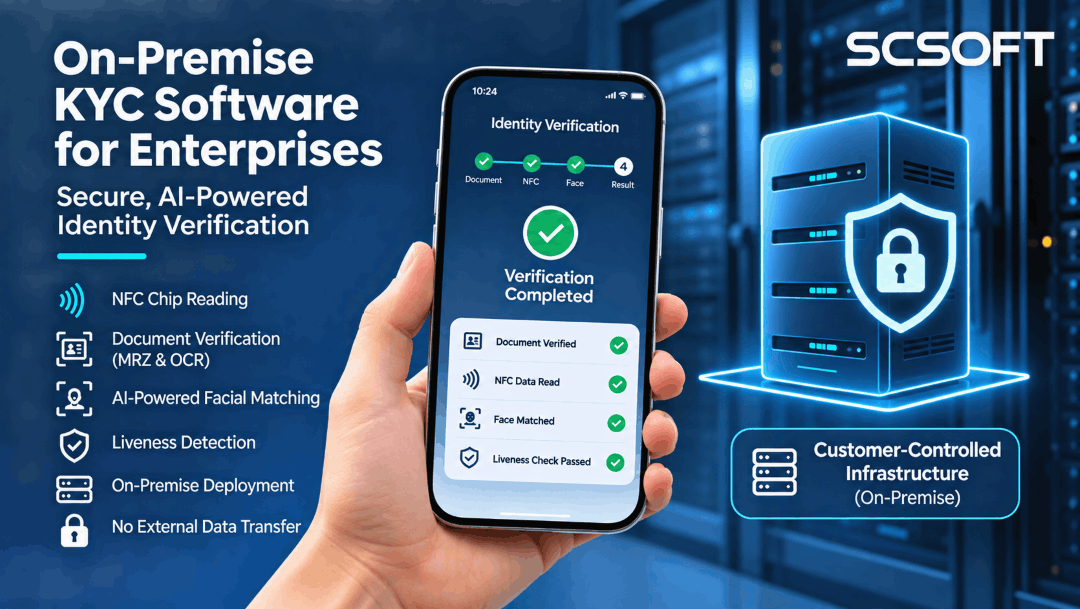
SCSoft provides on-premise KYC software designed for organizations that require identity verification capabilities within their own infrastructure. The solution combines document verification, NFC chip reading, AI-powered facial matching, and liveness detection without relying on externally hosted identity verification services.
What Is Enterprise KYC Software?
KYC (Know Your Customer) software helps organizations verify customer identities during onboarding and other identity-sensitive processes.
An enterprise KYC solution may combine several verification technologies:
- Identity document capture and data extraction
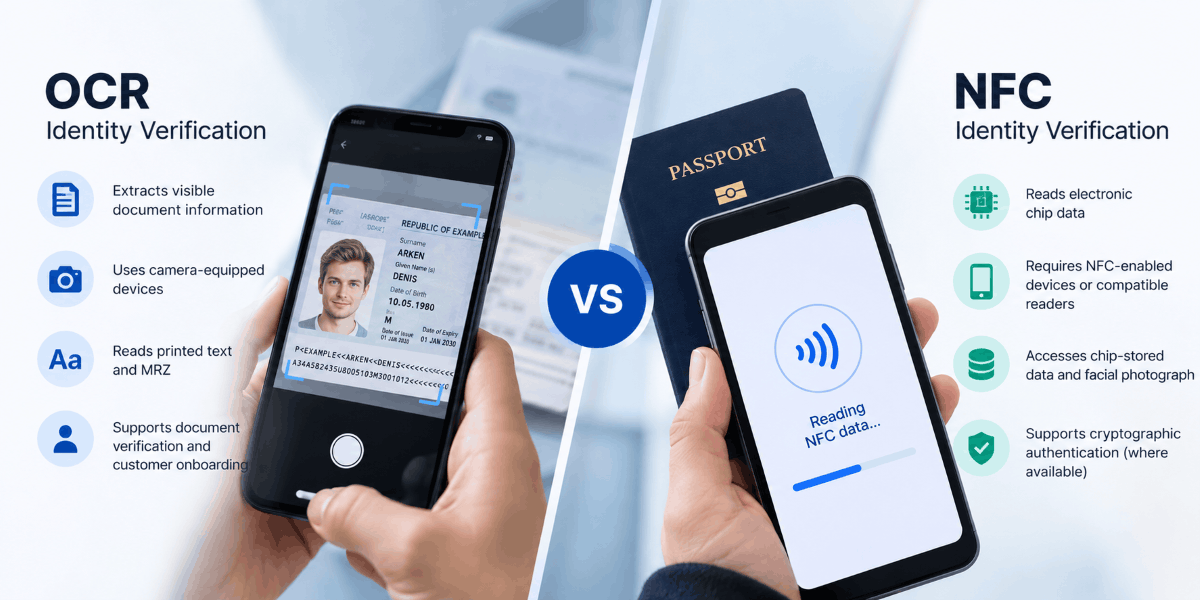
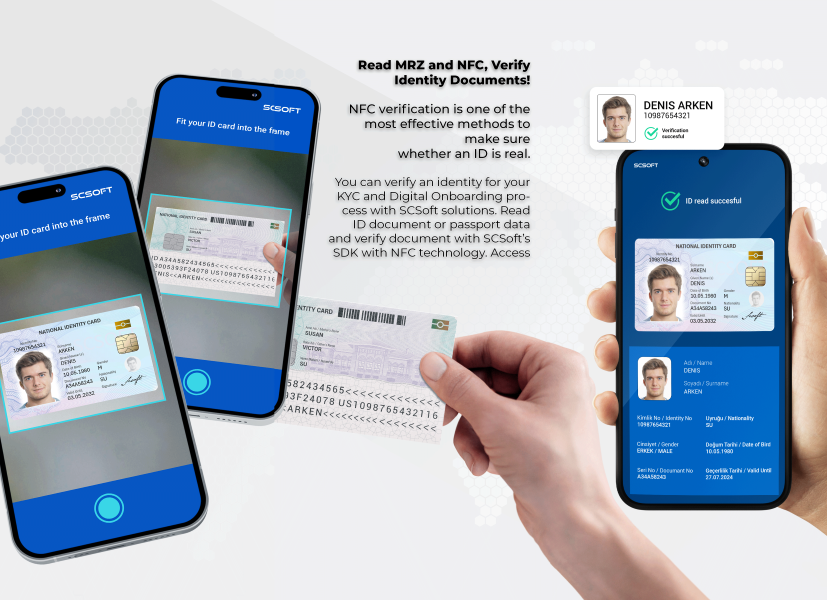
- MRZ reading for supported identity documents and passports
- NFC chip reading for supported electronic identity documents
- AI-powered facial biometric comparison
- Liveness detection
- Verification workflow management and reporting
- Integration with existing mobile applications and backend systems
These capabilities help organizations build consistent identity verification processes while supporting their internal security and operational requirements.
Why On-Premise KYC Software Matters
Many organizations evaluate cloud-based identity verification services alongside software deployed within their own infrastructure.
For businesses with strict data governance requirements, the deployment model can be a significant purchasing consideration.
Customer-Controlled Infrastructure
With an on-premise deployment, the KYC application and its supporting server-side components operate within infrastructure controlled by the customer.
SCSoft’s KYC solution has been deployed using this model, allowing organizations to operate identity verification services within their own server environments.
Identity Data Remains Within the Customer Environment
Identity verification can involve sensitive information, including identity document images, NFC chip data, facial photographs, and biometric verification results.
In SCSoft’s on-premise architecture, collected identity data is stored on the customer’s servers. The mobile SDK does not transmit identity verification data to external environments.
This architecture gives organizations direct control over the infrastructure used to process and store customer identity information.
AI Processing Without External Cloud Services
Some identity verification architectures rely on externally hosted services for biometric analysis.
SCSoft’s solution performs its server-side AI processing within the customer’s own infrastructure, including facial matching and liveness detection.
Organizations can therefore use AI-powered identity verification without sending biometric data to an external AI processing service.
Core Capabilities of SCSoft’s KYC Software
Identity Document Verification
The solution supports identity document capture and automated data extraction, helping reduce manual entry and improve consistency during onboarding.
MRZ reading is available for supported passports and identity documents.
NFC Identity Verification
SCSoft supports NFC chip reading for compatible electronic identity documents, including supported identity cards and electronic passports.
NFC provides access to information stored in the document’s electronic chip, including identity data and, where available, the holder’s facial image.
Cryptographic verification capabilities depend on the document type, issuing country, and availability of trusted certificate infrastructure.
For a detailed explanation, explore SCSoft’s NFC Identity Verification solution.
AI-Powered Facial Matching
SCSoft’s biometric verification technology compares the customer’s captured facial image with an available reference image from the identity document or NFC chip.
The processing takes place within the customer’s own server infrastructure.
Liveness Detection
Liveness detection helps assess whether the person participating in the verification process is physically present rather than presenting a photograph or replayed image.
Combined with facial matching, it adds another layer to the identity verification workflow.
Security-Focused Deployment Architecture
Enterprise identity verification software must fit into an organization’s broader security architecture.
SCSoft’s KYC solution is installed using a security-focused deployment topology within the customer’s environment.
The software has also undergone static code analysis as part of its security assessment activities.
Static code analysis can help identify potential software security issues, although it does not replace other security testing, operational controls, or ongoing vulnerability management.
By combining customer-controlled infrastructure with internal AI processing and security-focused deployment practices, SCSoft supports organizations seeking greater control over their identity verification systems.
Integration with Enterprise Applications
A KYC solution must work with existing customer onboarding processes rather than requiring organizations to rebuild their applications.
SCSoft provides mobile SDK integration options for:
- Native Android applications
- Native iOS applications
- React Native
- Flutter
These options allow development teams to incorporate identity verification into their mobile application environments.
For technical implementation details, read KYC Mobile SDK and Dashboard: Secure Identity Verification.
Operational Visibility and Verification Management
Identity verification does not end when a document is scanned or a biometric comparison is completed.
Enterprise teams also need tools for reviewing verification evidence, understanding workflow outcomes, and monitoring operational performance.
SCSoft’s KYC dashboard provides capabilities such as:
- Reviewing identity verification evidence
- Monitoring individual verification flows
- Role-based access control
- Visual reporting
- Server-side transaction and processing-time analysis
These capabilities help technical and operational teams manage the verification process within the organization’s own environment.
On-Premise vs. SaaS KYC Software
Both deployment models can support digital identity verification, but they differ in how infrastructure and operational responsibilities are organized.
| Consideration | On-Premise KYC Software | SaaS KYC Software |
|---|---|---|
| Hosting | Customer-controlled infrastructure | Provider-managed infrastructure |
| Data Storage | Within the configured customer environment | Depends on provider architecture and contractual arrangements |
| Infrastructure Management | Primarily customer-managed | Primarily provider-managed |
| Integration | Adapted to the organization’s infrastructure | Typically through hosted APIs or SDKs |
| Security Operations | Responsibilities defined between customer and vendor | Responsibilities defined by the SaaS service model |
| Deployment Planning | Requires infrastructure and installation planning | Typically requires less customer-managed infrastructure |
Neither model is automatically more secure or compliant. The appropriate choice depends on organizational requirements, implementation quality, governance, and operational controls.
SCSoft’s KYC solution is offered through an on-premise deployment model based on its established implementation experience.
How to Evaluate KYC Software for Your Organization
Before selecting a KYC software provider, enterprise buyers should consider several questions.
1. Where is identity data stored?
Understand where document images, biometric information, and verification results will reside.
2. Where does AI processing take place?
Determine whether facial matching and liveness detection require external cloud services.
3. Does the solution support NFC?
Check support for the identity document types and countries relevant to your customer base.
4. How does the software integrate with existing systems?
Evaluate supported SDKs, backend integration options, and operational dependencies.
5. What security assessment evidence is available?
Ask about static code analysis, security testing practices, deployment architecture, and the controls relevant to your organization’s requirements.
6. Can operational teams review verification activity?
Consider reporting, case review, role-based authorization, and troubleshooting capabilities.
Who Can Benefit from On-Premise KYC Software?
On-premise identity verification may be particularly relevant to organizations with demanding infrastructure, data governance, and operational requirements.
Potential use cases include:
- Banks and financial institutions
- Payment service providers
- Insurance companies
- Telecommunications operators
- Fintech platforms
- Enterprises managing sensitive identity verification processes
The suitability of a particular implementation should be assessed against each organization’s technical, security, and regulatory requirements.
Choose SCSoft for Enterprise Identity Verification
SCSoft combines NFC identity document reading, AI-powered facial matching, liveness detection, and enterprise verification management in an on-premise KYC solution.
All server-side AI processing and identity data storage remain within the customer’s infrastructure, while the mobile SDK does not transmit verification data to external environments.
Explore SCSoft’s KYC Identity Verification solution to learn more about the available capabilities.
Contact SCSoft to discuss your organization’s on-premise KYC requirements and request a product demonstration.