Introduction: NFC vs OCR in Digital Identity Verification
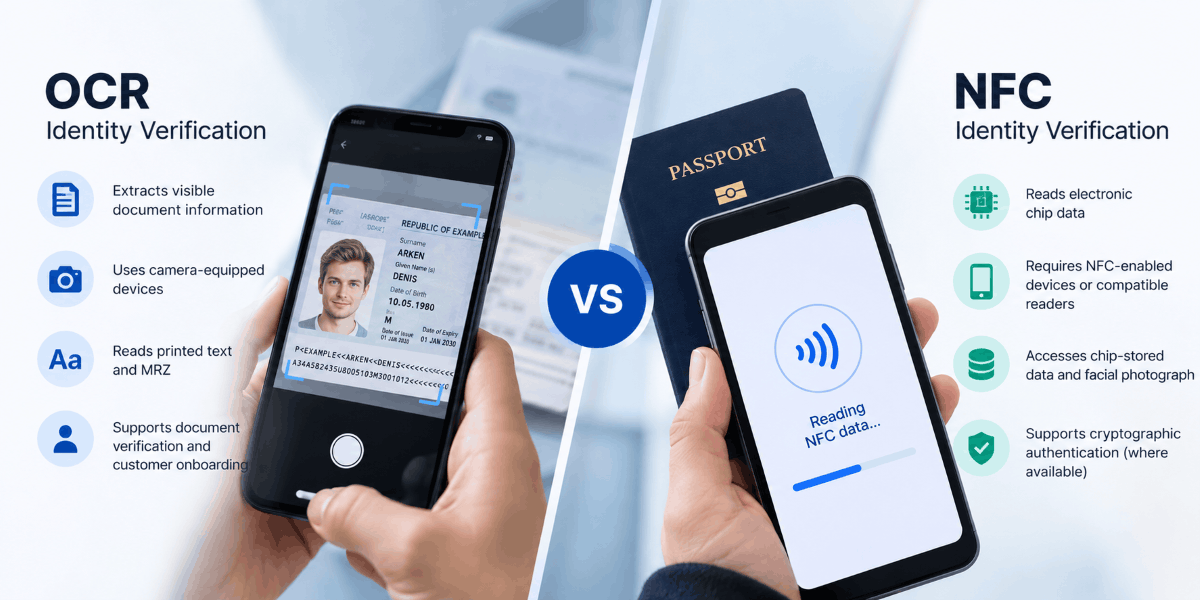
NFC vs OCR identity verification is an important comparison for businesses evaluating digital customer onboarding technologies. Both methods support Know Your Customer (KYC) processes, but they serve different purposes in identity document verification.
OCR extracts information from the visible surface of identity documents, while NFC reads electronic data stored in compatible identity document chips. Understanding these differences helps organizations choose the right combination of technologies for security, document compatibility, and customer experience.
Two widely used technologies in this process are Optical Character Recognition (OCR) and Near Field Communication (NFC). Although both technologies help organizations process identity documents digitally, they serve different purposes.
Understanding the differences between NFC and OCR helps organizations choose the right technologies for secure, efficient, and user-friendly digital identity verification workflows.
What Is OCR in Identity Verification?
Optical Character Recognition (OCR) is a technology that extracts text from images of identity documents, such as national ID cards, passports, and driver’s licenses. In digital identity verification, OCR helps organizations capture customer information without requiring manual data entry.
During the verification process, a customer takes a photograph of their identity document using a smartphone, tablet, or web camera. OCR technology analyzes the captured image and extracts relevant information, such as:
- Full name
- Date of birth
- Document number
- Document expiration date
- Other supported document fields
For passports and certain identity documents, OCR can also read the Machine Readable Zone (MRZ), which contains standardized identity information.
Benefits of OCR in Identity Verification
OCR offers several advantages for organizations implementing digital customer onboarding:
- Faster data capture: Reduces the need for manual entry of identity document information.
- Improved user experience: Simplifies the collection of customer information during registration.
- Broad device compatibility: Can operate through supported mobile and web-based applications using a camera.
- Integration flexibility: Can be combined with document analysis, biometric verification, and other KYC technologies.
Limitations of OCR
OCR primarily extracts information from the visible surface of an identity document. Although it can be combined with document authenticity checks, OCR alone does not cryptographically verify data stored in an electronic identity document’s chip.
Image quality, lighting conditions, document damage, and unsupported document formats may also affect recognition accuracy.
For organizations requiring additional document security checks, OCR can be complemented by NFC-based identity verification where compatible electronic documents and devices are available.
What Is NFC in Identity Verification?
Near Field Communication (NFC) is a short-range wireless communication technology that enables compatible devices to exchange data with electronic identity documents containing contactless chips.
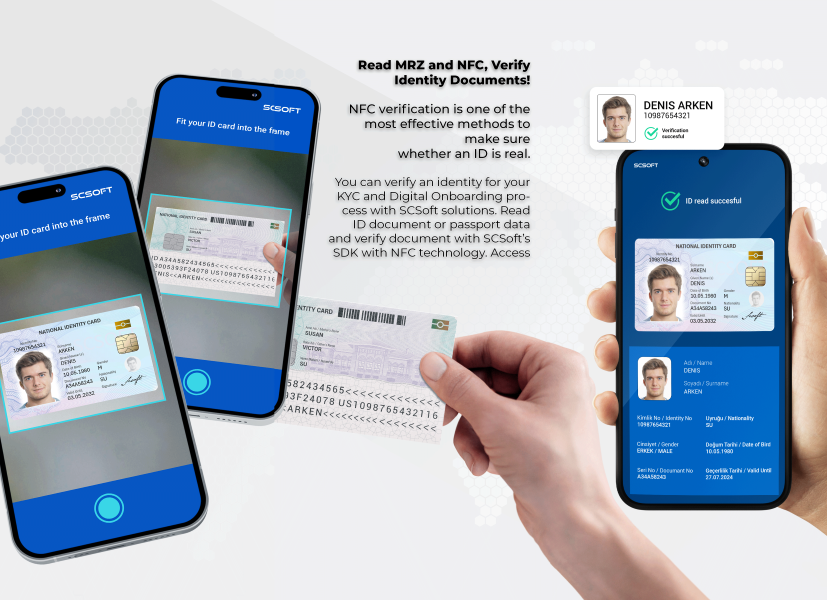
In digital identity verification, NFC allows organizations to read electronic information stored in supported national identity cards and biometric passports. Unlike OCR, which extracts visible information from document images, NFC accesses data stored electronically within the document’s chip.
How Does NFC Identity Verification Work?
A typical NFC-based identity verification process involves the following steps:
- Document information capture: The user scans the identity document, and the application obtains the information needed to access its chip.
- NFC chip reading: The user holds the document near an NFC-enabled smartphone or compatible reader.
- Electronic data extraction: The application reads supported data groups from the chip, which may include personal information and a digitally stored facial photograph.
- Chip security checks: Depending on the document and supported authentication mechanisms, the application performs cryptographic checks to assess data integrity and authenticity.
- Biometric verification: The electronically stored facial photograph can be compared with a live facial capture as part of the identity verification workflow.
NFC Security: Passive and Active Authentication
NFC-based identity verification can provide additional security checks beyond visual document inspection.
Passive Authentication (PA) verifies the digital signatures associated with chip data, helping establish that the data was signed by a trusted issuing authority and has not been modified. It does not, by itself, prove that the physical chip is genuine.
Active Authentication (AA) uses a cryptographic challenge-response mechanism to help verify that the chip possesses the corresponding private key, providing protection against certain chip-cloning attacks.
SCSoft supports both Passive Authentication and Active Authentication for Turkish electronic identity cards. For identity documents issued by other countries, the availability of these checks depends on the document’s security mechanisms and access to trusted issuing-country certificates.
Benefits of NFC in Identity Verification
- Electronic data access: Retrieves supported identity information directly from the document’s chip.
- Additional security checks: Supports cryptographic verification where compatible documents and trusted certificates are available.
- Biometric integration: Enables facial comparison using the chip-stored photograph when accessible.
- Complementary technology: Works alongside OCR, document analysis, and liveness detection in digital KYC workflows.
Limitations of NFC
NFC verification requires a compatible electronic identity document and an NFC-enabled device or reader. Chip access methods, available data groups, and authentication capabilities may differ between document types and issuing countries.
For this reason, organizations often combine NFC with OCR and other identity verification technologies rather than relying on NFC as the only verification method.
NFC vs OCR: Key Differences in Identity Verification
Although NFC and OCR are both used in digital identity verification, they perform different functions. OCR extracts information from the visible surface of an identity document, while NFC reads electronic data from a compatible document’s chip.
The following comparison highlights the main differences between these technologies.
| Feature | OCR Verification | NFC Verification |
|---|---|---|
| Primary function | Extracts visible document information | Reads electronic chip data |
| Technology | Optical Character Recognition | Near Field Communication |
| Document requirements | Supported document with readable visual fields | Compatible electronic identity document with a chip |
| Device requirements | Camera-equipped device | NFC-enabled device or compatible reader |
| Data sources | Printed text and machine-readable zones (MRZ) | Supported electronic data groups stored in the chip |
| Facial photograph | Can use the visible document photograph | Can access the chip-stored facial photograph when available |
| Document security | Can be combined with visual document authenticity checks | Can support cryptographic authentication, depending on the document |
| Chip authenticity verification | Not available through OCR alone | Supported authentication mechanisms may help detect certain chip-cloning attacks |
| Typical applications | Document data capture, digital registration, customer onboarding | Electronic identity verification, additional document security checks, biometric verification |
| Integration | Mobile and web-based workflows | NFC-compatible mobile devices and supported readers |
Is NFC More Secure Than OCR?
NFC can provide stronger evidence of electronic document data integrity and authenticity when supported cryptographic checks are successfully performed.
However, NFC and OCR should not be treated as direct replacements for each other. OCR is useful for extracting visible information and supporting a broad range of document types, while NFC provides access to electronic chip data and additional security capabilities where supported.
For organizations implementing digital KYC, combining OCR, NFC, facial biometric matching, and liveness detection can provide a more comprehensive identity verification workflow than relying on a single technology.
Which Technology Should Businesses Choose: NFC, OCR, or Both?
Choosing between NFC and OCR depends on the types of identity documents an organization needs to verify, the devices its customers use, applicable regulatory requirements, and the level of assurance required for each verification process.
When Should Businesses Use OCR?
OCR is particularly useful when organizations need to:
- Capture customer information from identity documents quickly.
- Support document-based onboarding through mobile and web applications.
- Process identity documents that do not contain compatible NFC chips.
- Reduce manual data entry and improve registration workflows.
OCR is often an important starting point for digital identity verification, especially when combined with document analysis and biometric checks.
When Should Businesses Use NFC?
NFC is especially valuable when organizations need to:
- Read electronic data from supported identity cards and biometric passports.
- Access chip-stored facial photographs for biometric comparison.
- Perform supported cryptographic document authentication checks.
- Add further security controls to identity verification processes involving compatible electronic documents.
The available NFC security checks depend on the document type, issuing country, and supported authentication mechanisms.
Why Combine NFC and OCR?
For many organizations, the most practical approach is to use OCR and NFC together within a single digital identity verification workflow.
OCR can capture visible document information and help initiate the verification process. When a compatible NFC-enabled document and device are available, NFC can provide additional electronic data and supported authenticity checks.
Facial biometric matching and liveness detection can further support the verification of the person presenting the document.
A combined approach allows organizations to design identity verification workflows that balance security requirements, customer experience, and document compatibility.
How SCSoft Supports Digital Identity Verification
SCSoft provides digital identity verification technologies for organizations implementing KYC and remote customer onboarding processes.
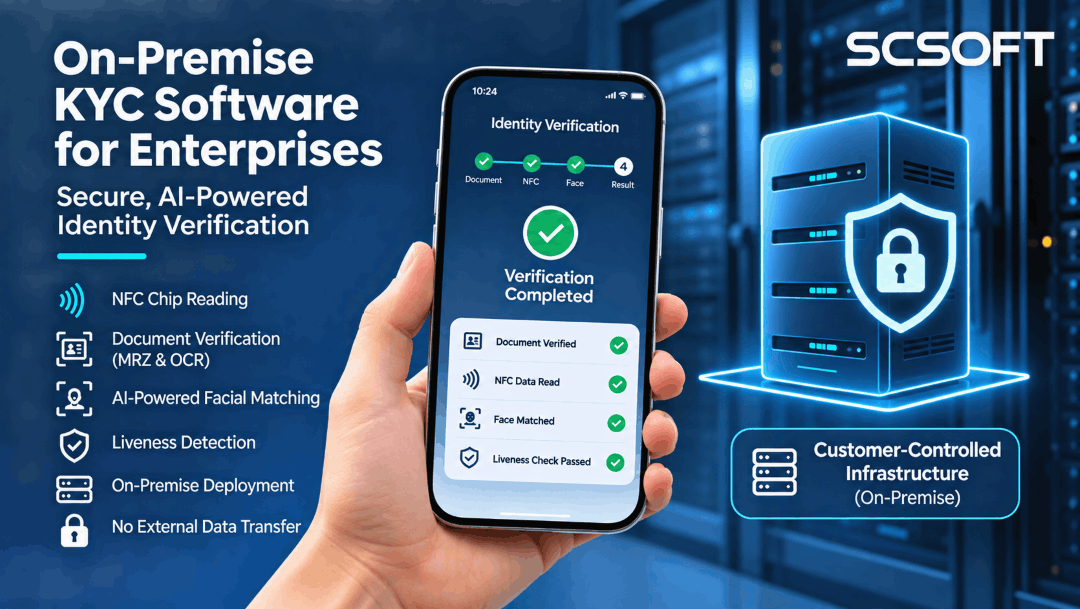
Its solutions support identity document data capture, NFC chip reading, facial biometric matching, liveness detection, and automated or video-assisted verification workflows.
Organizations can explore SCSoft’s KYC Identity Verification Solution for end-to-end customer onboarding or learn more about its dedicated NFC Identity Verification Solution.
For technical integration requirements, product demonstrations, or commercial inquiries, contact SCSoft.